
Principle of Economics
Principle of Economics plays an important role in our daily lives. From deciding what to buy at
the grocery store to understanding how governments manage money, economic decisions affect
everyone.
Economics is mainly about making decisions when there is scarcity. Since resources like time,
money, and natural materials are limited, people must choose how to use them efficiently. By
studying the principles of economics, we can better understand how markets operate and how
economic systems function.
The main thing that economics is about is how to make choices when there isn’t enough of
something. People need to learn how to make the most of the few resources they have, like
time, money, and natural resources. If we learn the basics of economics, we can better
understand how markets and economies work.
Table of Contents
What Are the Most Important Ideas in Economics?
How Important Economics Is
The Ten Rules of Money
In economics, supply and demand
The Cost of Opportunity When You Have to Choose
Microeconomics and Macroeconomics
Examples of Economics in the Real World
To sum up,
What are the most important ideas in economics?
The basic rules of economics tell people and groups how to use the resources they have. These
ideas help us understand how markets work, how people decide things, and how governments
change the economy.
Economics tries to answer three main questions:
What kinds of goods and services should be produced?How should they be made?
Who should get them?
A lot of people want things, but there aren’t enough resources for everyone. That’s why these
questions are so important.
Why Economics Matters
People can make better choices in their daily lives if they know the basics of economics.
Economics helps governments make rules that help the economy grow, businesses make plans,
and people keep track of their money.
Here are some reasons why economics is important:
helps you manage your money better
tells you how the markets work
helps governments deal with unemployment and inflation
helps people figure out what to do with their businesses
makes it easier to share resources
In short, economics teaches people how to use their resources wisely.
The Ten Rules of Economics
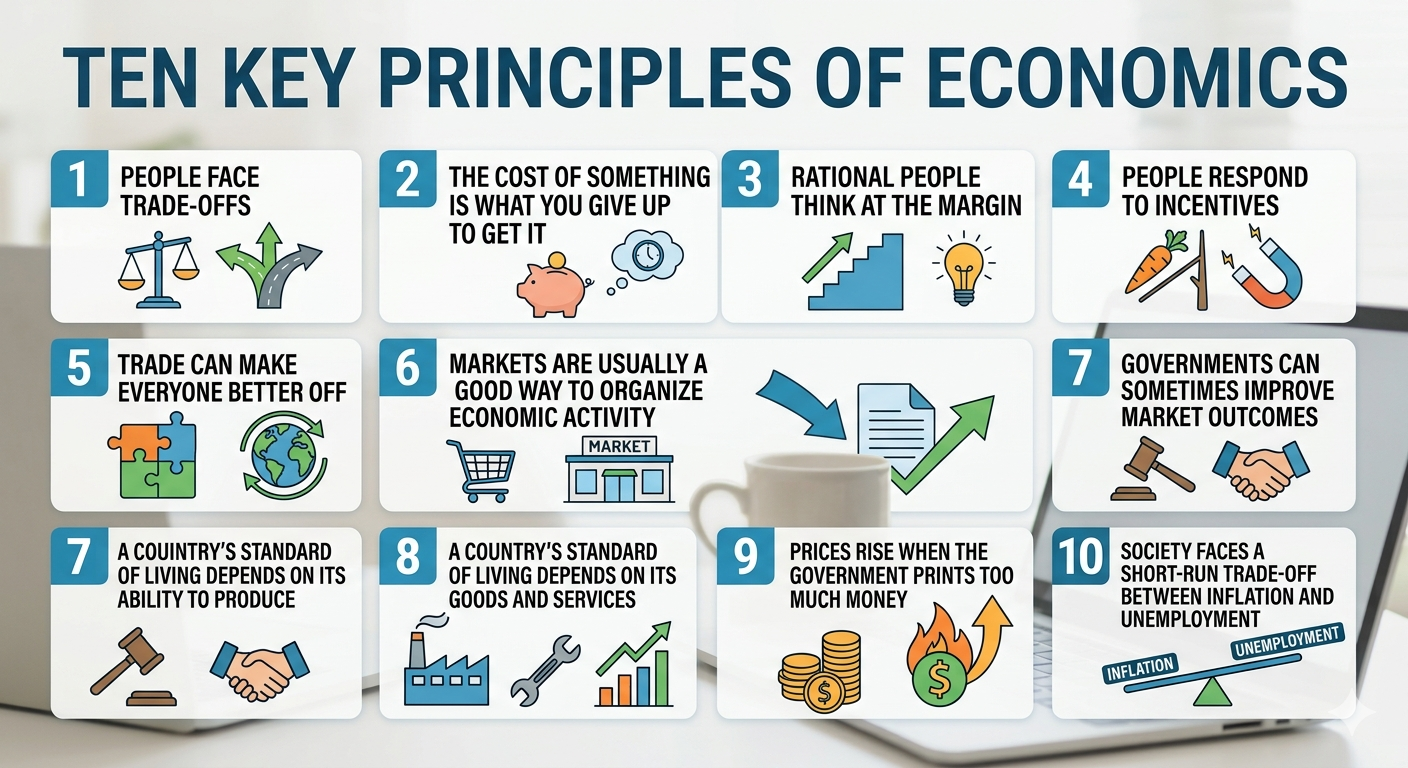
N. Gregory Mankiw, a well-known economist, wrote down the ten main ideas that make up the
field of economics.
- People need to make choices.
We usually have to give up something to get what we want. - The cost of something is what you give up.
This is called “opportunity cost.” - People who are reasonable think outside the box.
When people make choices, they think about the costs and extra benefits. - People respond to rewards
Incentives affect the choices people make. - Trade is good for all.
People can concentrate on a single aspect and benefit from trade. - In general, markets are a good way to organize how people do business.
People can talk to each other in markets and agree on prices for things they want to buy and
sell. - Governments Can Make Markets Work Better
Governments sometimes get involved to make things more fair or better. - The standard of living in a country is affected by how productive it is.
More productive work means better living conditions and more money. - Prices go up when governments have too much money.
When there is too much money in the economy, prices can go up. - In the short term, society must choose between job loss and inflation.
Policies about the economy can change both prices and jobs.
Demand
Demand is how much people want to buy.
When demand goes up but supply stays the same, prices usually go up. When the supply goes
up and the demand stays the same, prices usually go down. The market price of things is based
on how much demand there is for them and how much supply there is.
The Cost of Opportunity When You Make Decisions
The cost of opportunity is one of the most important ideas in economics. If you have to pick
between two things, it means you have to give up the value of the next best thing.
The opportunity cost of a student who chooses to study economics instead of working is the
money they could have made by working part-time.
People can make better decisions if they know what oppurtunity cost is.
Microeconomics and macroeconomics
Microeconomics looks at small economic units, like people, families, and businesses. It looks at
things like how much things cost, how people buy them, and how much they are worth.
Macroeconomics is the study of the economy as a whole. It looks at things like the economy’s
growth, inflation, unemployment, and the amount of money the country makes.
Economics in the Real World
A lot of real-life situations call for you to use economic principles:
A business setting the price for a good
A government that makes tax laws
A family deciding how to use the money they make each month
A company that is thinking about hiring more workers
These examples show that economics is both a way to think about things and a way to make
decisions in the real world.
Conclusion
Economics helps us understand how people, businesses, and governments make choices in a
world with few resources. If people know these things, they will be able to better understand
economic issues and make better financial choices.
It might be hard to understand economics at first, but its main ideas are simple and helpful.
Learning the basics of economics can help anyone who wants to know more about how the
economy works, whether they are a student, a professional, or just curious.